
Sales Safety Engineering OS
Enterprise outbound:
"Should we keep going?"
Answered monthly, in data.
Relationship LLC / Shuhei Hashimoto, Managing Partner / Head of LOGOTORU
TABLE OF CONTENTS
Table of contents
WHY — The structural crisis in enterprise outbound
- 03 About me
- 04 The problem: no one is allowed to say "stop"
- 05 The list is finite. There is no replacement
- 06 Sloppy outbound burns the market for good
- 07 Are you watching the leading indicators of burnout?
WHAT — What LOGOTORU is
- 08 What LOGOTORU is
- 09 Why we can do this
- 10 Manager view
- 11 Operator / Raw Data
- 12 Decision log and monthly report
VALUE — What you have at month 6
- 13 What you can say after 6 months
- 14 Our 4 differentiators
- 15 Scope and pricing
- 16 The biggest ROI — protecting the future TAM
PROOF — Track record and alternatives
- 17 Customer voices / case studies
- 18 Comparison with alternatives
- 19 FAQ
NEXT STEPS
- 20 Next step / company info / contact
About me
Shuhei Hashimoto
橋本 周平
Relationship LLC
Managing Partner / Head of LOGOTORU
Enterprise BDR at Salesforce and AWS.
Hit quota every quarter at both Salesforce and AWS. At Salesforce, secured 50 meetings with director-level-and-above decision makers in about a year. Earlier, launched an inside sales team and managed 20+ partner reps.
I repeatedly saw enterprise outbound motions exhaust the market faster than expected. The need to make continue / stop decisions on data — not gut feel — is why LOGOTORU exists.
PROBLEM
"Push harder" is always said.
No one is empowered to say, "Stop here."
Enterprise outbound is structured to only step on the accelerator. Stop/pullback decisions are run on instinct — and by the time you notice, you've burned the market itself.
No threshold and no authority to say "stop"
You can't explain a pullback in numbers, so you can't stop. Continue / adjust / stop is gut-feel; replace the person, replace the answer.
You keep pushing a market that no longer responds
Prospects fatigue; brand impression erodes. A burned market does not come back.
When to pull back is never recorded
When, where, and why the market started to slip — no one can explain. The decision history simply doesn't exist.
STRUCTURAL CONSTRAINT
The list is finite. There is no replacement.
Of all Japanese corporations, the enterprise tier (publicly listed enterprise tier) is a tiny minority.
TARGET
4,000 accounts
Enterprise tier / ~0.1% (our estimate)
TOTAL
4M companies
All Japanese corporations (our estimate)
CRITICAL RISK
List exhaustion is irreversible
Unlike SMB, once the list is exhausted you cannot just "buy the next list".
A market once lost does not easily come back.
Recovery after a negative response — only 12 of 74 rejection / defensive responses turned positive at the next contact (LOGOTORU OS records). More than 80% did not come back
MARKET BURNOUT RISK
Sloppy outbound burns the market — for good
"Sloppy approach" accumulates negative sentiment and becomes hard to reverse (only 16% turned positive after a negative response, n=74)
High-volume activity without strategy
"Spray and pray" tactics / low-quality talk tracks
Negative sentiment accumulates
"Pushy" and "annoying" brand impressions stack across the market
Locked out of the market
For years afterward, you can no longer approach that market — an irreversible state
Are you watching the leading indicators of burnout?
From cross-client data — a rise in negative response rate has tended to be followed, about 3 months later, by a drop in conversation success rate (correlation between the negative rate 3 months earlier and this month's conversation success rate: r = −0.69, 26 months).
Illustration (not measured values)
"This month's negative rate" tends to show up in "the conversation rate 3 months from now".
By the time meeting count or revenue drops, the market is already worn down.
What LOGOTORU is
A decision operating system that lets enterprise outbound teams explain "continue / adjust / stop"
WHAT WE DON'T DO
We do not declare the "right answer"
Calling the "correct answer" for a market or industry is not our role
We do not predict the future
No demand forecasting model, no probability distribution
We do not make the decision for you
Final decision is the executive's. LOGOTORU supplies the evidence
We do not guarantee meeting count
Maximizing decision quality — not meeting count — is the goal
WHAT WE DO (CORE VALUE)
Assemble the facts (logs) needed for decisions
Not fragmented activity history — structured data shaped for decision-making.
Preserve the reasoning over time
Hypothesis → response → interpretation → decision. We save the "why we thought so" context.
Make decisions auditable in hindsight
Not outcome-only reporting — verify whether the decision was sound at the time it was made.
Why we can do this
DATA FOUNDATION
A proprietary data foundation built for enterprise outbound (monthly verdict on 5 indicators + analysis by industry, role, and channel)
We structure the qualitative data — conversation analytics and more — that traditional SFA/CRM cannot capture, and deliver it as a decision-making dashboard.
Market Pivot
Industry-level market health, one screen
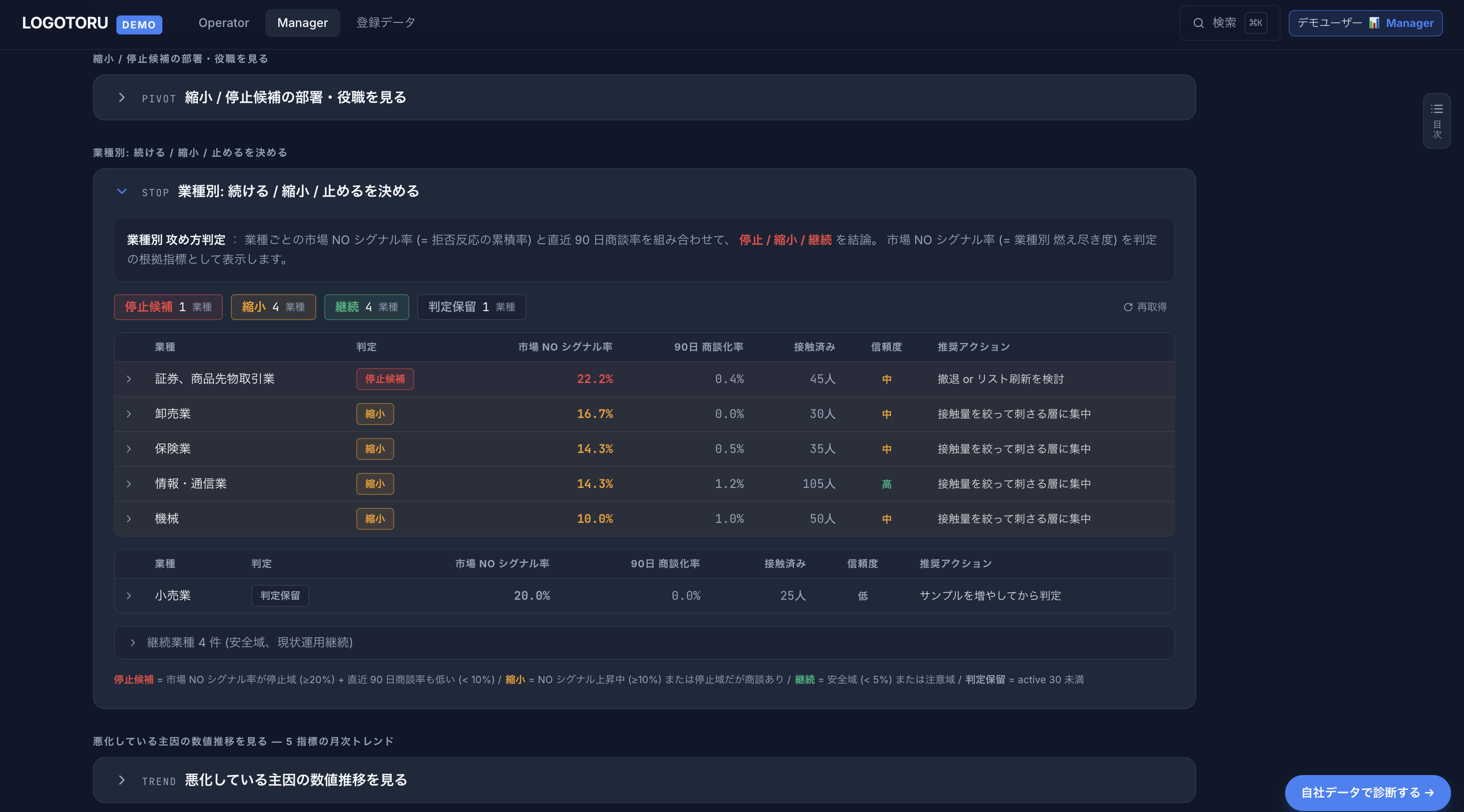
Industry Verdict Health Score Trend View Coverage Map
Where to attack next, in map form
Priority Contacts Engagement Map Next Target List PRODUCT — MANAGER
What a decision looks like — Manager view
One screen for "this month's decision." CONTINUE / ADJUST / STOP with the reasoning and the next action attached.
Verdict
Drivers
Next Action
Hero badge
Verdict, first
CONTINUE / ADJUST / STOP at the top (NO VERDICT when the month has too little data — 4 states). The verdict for this month is visible without scrolling.
Drivers + issues
Three drivers only
Concentrates the discussion on three drivers — e.g. a worsening negative response rate — rather than burying you in metrics.
Accept + history
Next action flows automatically
Rule-based improvement suggestions (worded by AI) are stamped "accept / reject" and rolled forward into next month's outcome validation.
PRODUCT — OPERATOR / RAW
No guessing — today's priority contacts and next actions.
OPERATOR
Today's Top 5 to engage
Focus on the top 5 by composite score — temperature, department, and response history combined into a single ranking.
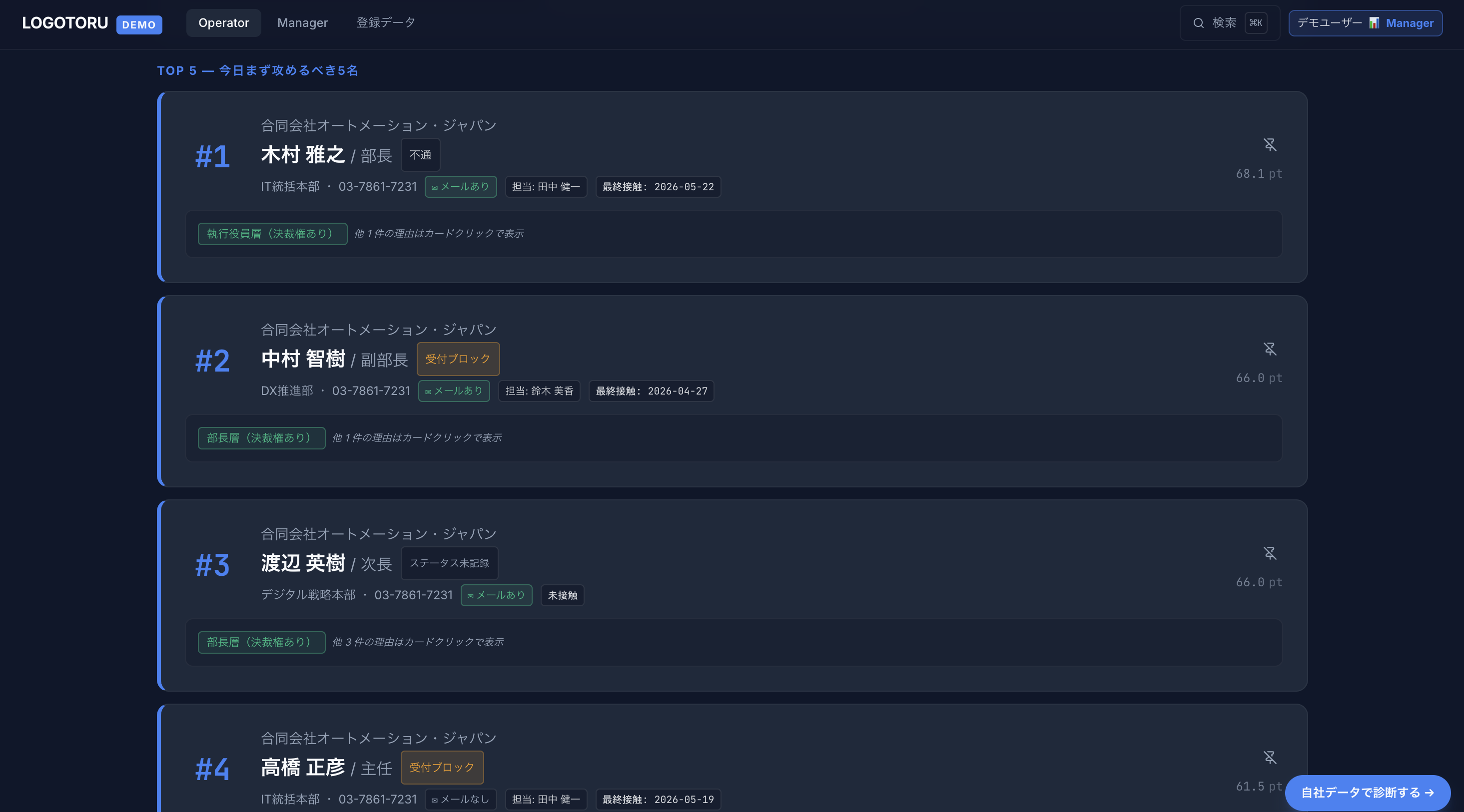
Priority Contacts Score Rank Next Action RAW DATA — Deals
Input flows straight back into the decision
Meeting count, pipeline, closed-won amount, and win rate visualized in real time — wired directly into the monthly report.
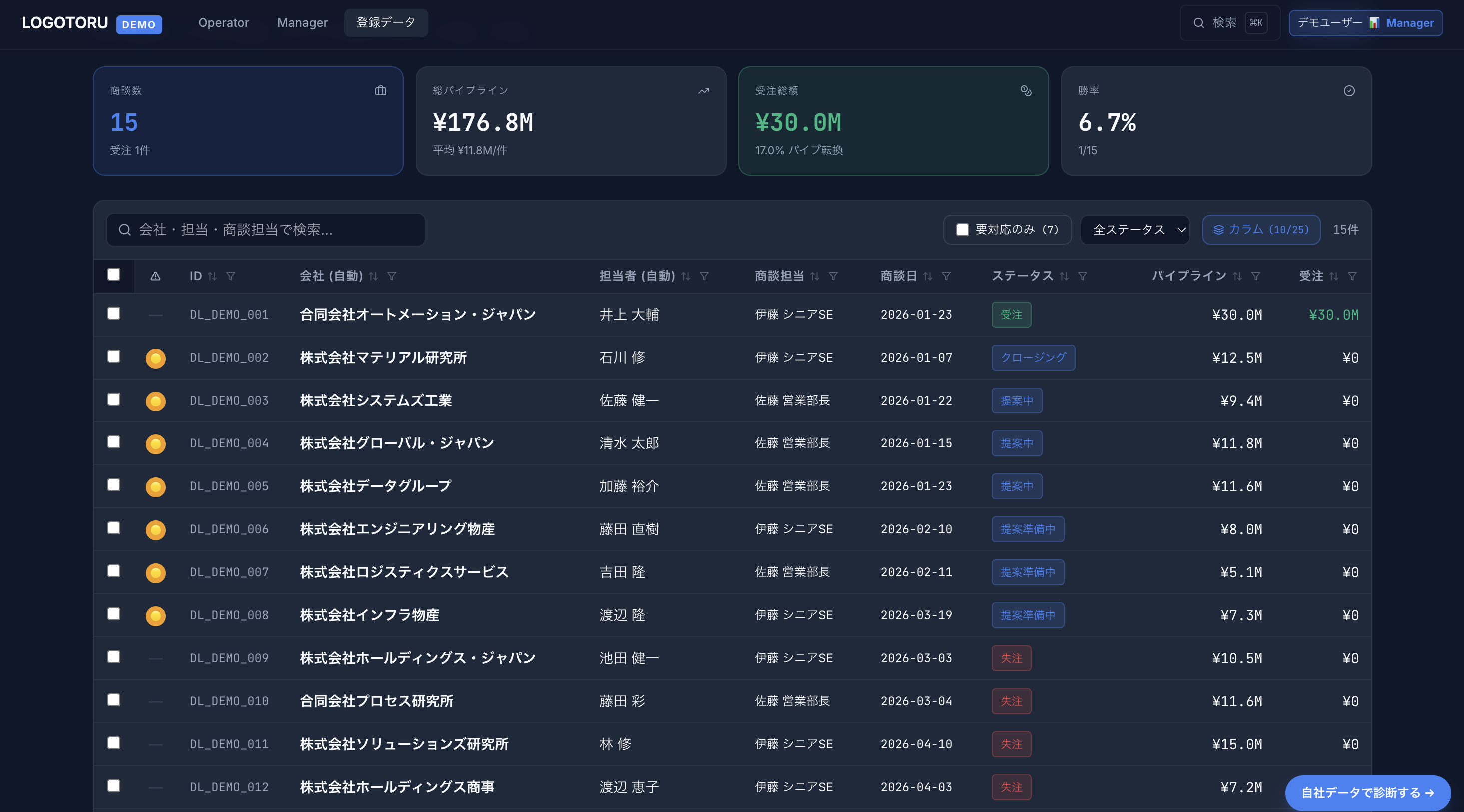
Raw Data Pipeline Monthly Report Designed to support both execution and verification
Operator delivers "zero-hesitation execution." Every change to thresholds, coefficients, and verdicts is recorded in the decision_log, preserving full accountability.
DECISION TRAIL
An audit trail of decisions you can explain to the board
Through the monthly report and the decision-log timeline, the rationale behind every call is preserved.
REPORT — Monthly report
Ask "should we continue?" every month
Verdict, drivers, and next action in one report — board-ready quality.
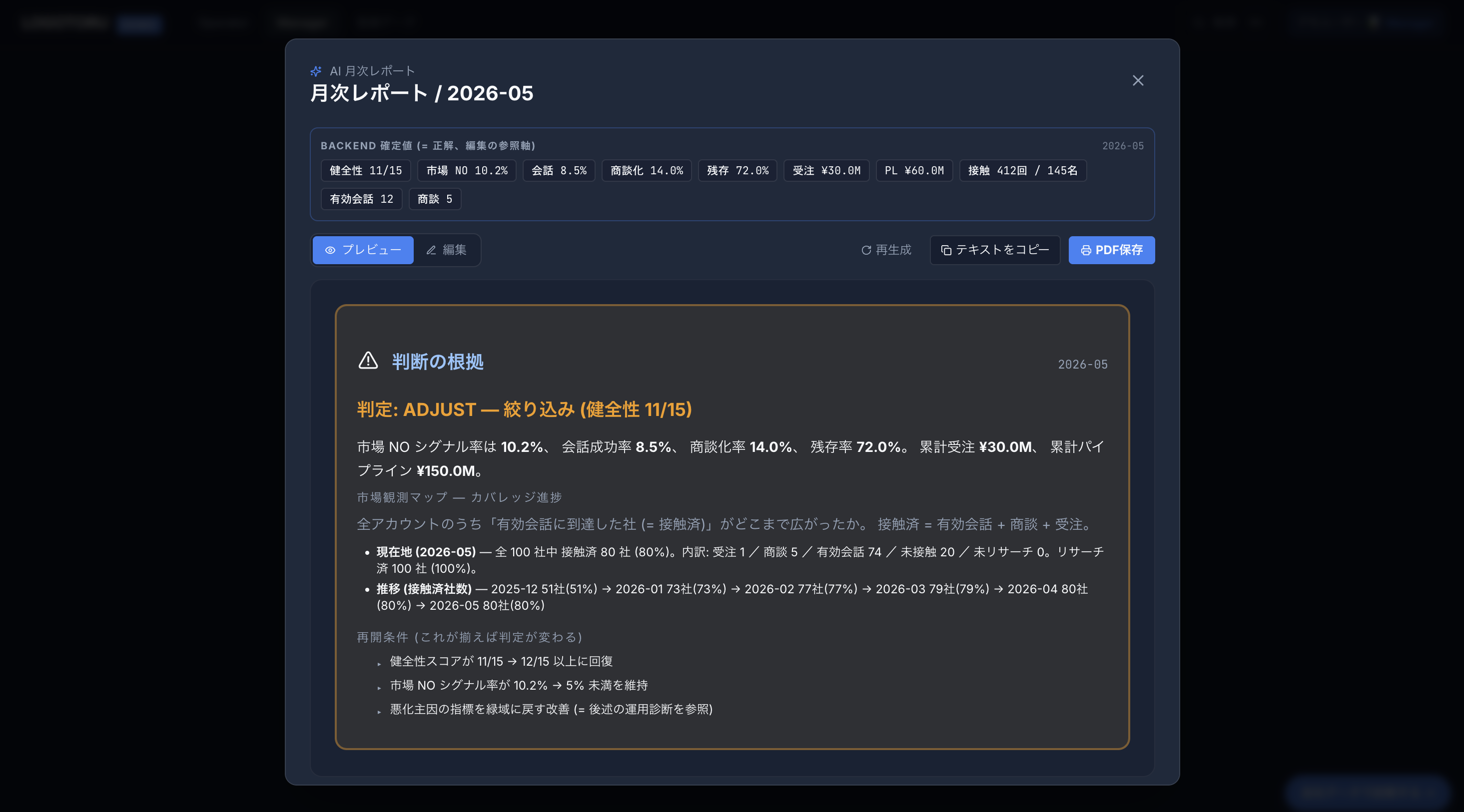
Verdict Drivers Monthly Report TIMELINE — Decision log
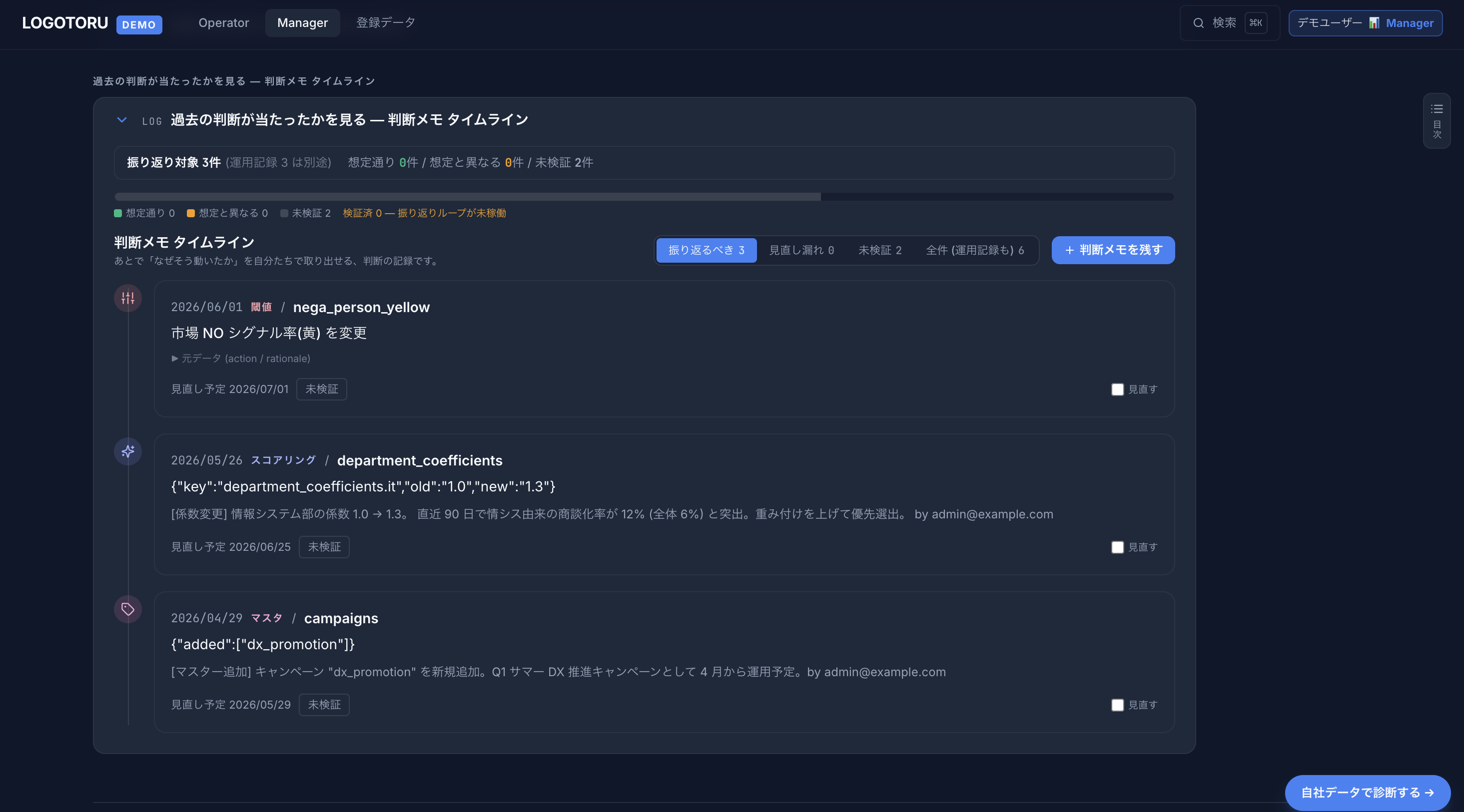
Why each move was made is preserved
Threshold changes, coefficient updates, master additions — decision-related changes recorded in chronological order.
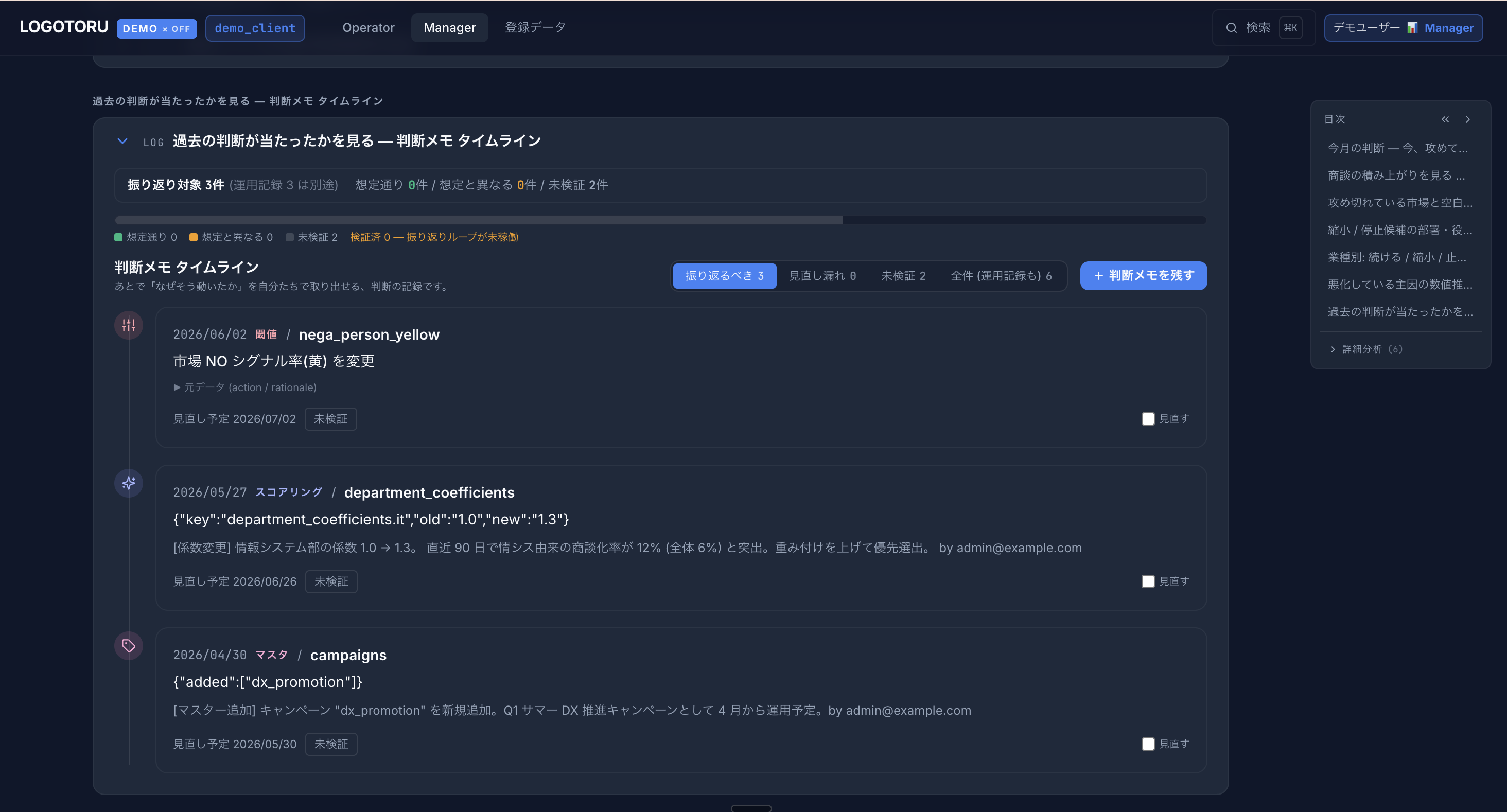
Decision Log Rationale Timeline "Should we keep investing in this BDR motion?" — answered every month, in writing.
Paired with the decision log, accountability is preserved and recoverable on demand.
What you can say after 6 months
DELIVERABLES — Decision foundation in hand by month 6
Market health benchmarks
Conversation success rate, negative response rate, market NO-signal rate, residual rate — set for your company, with every industry judged against the same thresholds
Market recovery rate
Measure how often once-negative prospects return to positive — quantify market elasticity
Validity of BDR investment
ROI computed from market health score and list-lifetime forecast
Winning patterns by industry / role
A/B test results turned into language for messaging, list, and role targeting
Explain to your boss with the decision report
A reason set for continue / stop / adjust
DECISIONS — Decisions you can make by month 6
Able to explain "why we continue" in numbers and logic
Able to articulate what to change — list, script, or target
Able to explain "why we stop now" against a defined exit threshold
Not just outcomes (meetings or revenue) — accountability for the decisions themselves, built in 6 months.
Observation-driven execution for a decision OS
Not sales outsourcing — observation-driven execution as a decision OS. The 4 dimensions we deliver.
TEAM DESIGN
Execution and decision-making are not separated
→ Raw signal flows straight into the decision
The founder, Hashimoto, directs every engagement personally. Execution and decision-making are never split. Operator is, in principle, fixed (1 person per account) to maximize learning curve.
OBSERVATION DESIGN
Execution designed to capture observation data
→ "Channels that work / channels that do not" become identifiable
Call and email are the base observation channels, with letters and LinkedIn added by plan (every response is recorded in LOGOTORU OS). We identify "which contact point works" by industry, department, and role.
POPULATION DEFINITION
Define the market population required for decision-making
→ "Who to reach" is structured by name
Using public personnel data, we define the decision-maker universe across industry × role × company size, and structure it down to named individuals.
DECISION REPORT
Ask every month: should BDR investment continue?
→ Continue / exit, explainable to the board
Every month we report whether to keep investing in this BDR motion. Continue / stop / adjust — reported at board-ready quality.
Scope and pricing
PROVIDED — 3-piece bundle
Decision OS design
Metric definitions, threshold design, dashboard build (LOGOTORU OS). Configured to your continue / stop criteria.
Monthly decision review
Continue / stop / adjust rationales structured; the basis for the decision made explicit. Board-meeting-ready quality.
Observation execution (BDR)
Observation by call and email, plus letters and LinkedIn depending on the plan, with response classification and log entry (all recorded in LOGOTORU OS) — under the founder's direction.
LOGOTORU is not a sales outsourcing vendor. It is a decision OS to minimize the loss from misjudgment.
PRICING — MONTHLY (EXCL. TAX)
LIGHT
Call + email
¥800K
STANDARD
+ Letters, up to 100 / mo (each tracked by QR)
¥1M
PREMIUM
+ LinkedIn, 50 people / mo
¥1.2M
All plans: Decision OS + monthly review + 1 dedicated operator
6-month minimum (then cancellable by written or email notice at least 30 days before the desired end date)
If we recommend ending the whole service (exit recommendation), you may cancel without penalty within the minimum term by notifying us within 10 business days of receipt (fees accrued to the cancellation date remain payable)
Additional operator: ¥600K / mo per person (approx. 120 hours)
The biggest ROI is protecting the future target-account list
TARGETS
100 accounts
Target accounts
AT RISK
5 accounts
Accounts expected to go negative
LTV
¥30M
Expected LTV per account
Month 1
Month 2
Month 3
Month 4
Month 5
Month 6
Traditional
No basis to stop;
sloppy outbound continues
LOGOTORU
Detect negative signal early;
stop at the right month
↑ LOGOTORU: strategic exit decided in month 4; stopped from month 5
① BURNED scenario
5 accounts × ¥30M
= ¥150M lost
Future loss
② PRESERVED scenario
100 accounts × ¥30M
= ¥3B
Future value of the whole market (what you keep is the accounts that did not go negative)
* Illustrative computation: LTV ¥30M, 5/100 accounts going negative. Actual values vary by customer.
Customer voices / track record
Track record concentrated in high-ACV services (ARR ¥10M / ~$65K+). Validated patterns specifically in enterprise BDR.
EdTech
→ Decision-maker approach now an internal asset
“The "decision-maker approach playbook" now lives as an internal asset. Sales tends to be personality-driven, but we now have real repeatability.

Life is Tech
Ms. Ichikawa / DX Division
SaaS
→ Quality meetings, mostly at division-head level
“Not forced meetings — customers come having understood the service and prepared questions. The mix of senior-level meetings, including executive officers, has been notably high.

X-bit
Mr. Kawai / CBO
Legal Tech
→ Deep understanding and interest before the meeting
“By the time we enter the meeting, the prospect already has significant understanding and interest. Compared to traditional cold calling, we have achieved roughly 5x the meeting acquisition rate.

Legalscape
Mr. Kaneko / Business Strategy
Cybersecurity
→ TSE Prime, Division-Head class meetings secured
“A meeting-acquisition KPI originally planned over 6 months was hit in just 3.

Forcepoint Japan
Head of Japan Sales
Sales Consulting
→ Customized letters broadened ORIT's offering
9 enterprise meetings in the first month of operation. Letters customized one by one broadened the range of sales-support services ORIT can propose to its clients.
Our summary of the engagement (not a customer quote)

ORIT
Mr. Ishikawa / CEO
Customers and partners

Comparison with alternatives
LOGOTORU occupies the position "log capture + decision support, unified." Clearly differentiated from meeting-count outsourcing and from internal BI upgrades.
FAQ
Q. Won't bringing in an external party demoralize our in-house BDR team?
A. The opposite. LOGOTORU exists to show "doing more under these conditions is a business loss." We bring it in to free your team from inefficient activity.
Q. ¥800K+/mo is expensive. Aren't trade shows or ads better?
A. There is no setup fee. If you want to lock in the strategy and decision-maker list first, you can start with the Outbound Design Package (¥500K), fully credited if the monthly plan starts within 60 days. If the monthly retainer helps you identify the right moment to stop early, you avoid tens of millions to hundreds of millions of yen in subsequent loss. This is not a one-off campaign spend — it is infrastructure that improves the efficiency of your entire marketing budget.
Q. Couldn't we just enforce log entry on our internal BDR team and analyze it ourselves?
A. Theoretically yes. Practically very difficult — psychologically and structurally. Asking the people doing the work to objectively record "data that may reduce the need for their activity" carries a powerful bias.
Q. If we end up deciding to exit, isn't the BDR investment wasted?
A. On the contrary — it's the biggest return (loss avoidance). The tens of millions to hundreds of millions of yen in losses from hesitant continuation can be locked in and stopped. This "cutting losses" is itself one of the executive wins.
Q. Won't aggressive BDR execution come across as pushy and damage the brand?
A. Making that exact risk visible and controlling it is the essence of LOGOTORU. We continuously measure the "market NO-signal rate" (the share of people who have rejected you) and flag ADJUST at the caution line (5%) and STOP at the stop line (20%).
Q. We're not at the tightly-managed phase yet. Can we just wait and see?
A. Have you defined the deadline for "wait and see" and the criteria for the decision at that point? Continuing without those is not strategic patience — it is decision deferral.
NEXT STEPS
BDR Market Health Assessment — 3 minutes
Get an evidence-based view of whether there is still room in your enterprise market and whether the investment is still rational, via 11 questions (5 required, about 3 minutes).
SCAN ME
WHAT HAPPENS AFTER THE ASSESSMENT
COMPANY INFO
- Company
- Relationship LLC
- Address
- Navi Shibuya V 3F, 5-5 Maruyama-cho, Shibuya-ku, Tokyo 150-0044, Japan
- Business
- Enterprise outbound support / LOGOTORU OS development
- Managing Partner
- Shuhei Hashimoto
- Founded
- April 1, 2024
CONTACT INFORMATION
Managing Partner / Head of LOGOTORU
Shuhei Hashimoto
LOGOTORU does not promise success.
What it does is make the decision — "continue with confidence when metrics are within thresholds, exit openly when they are not" — explainable in data.